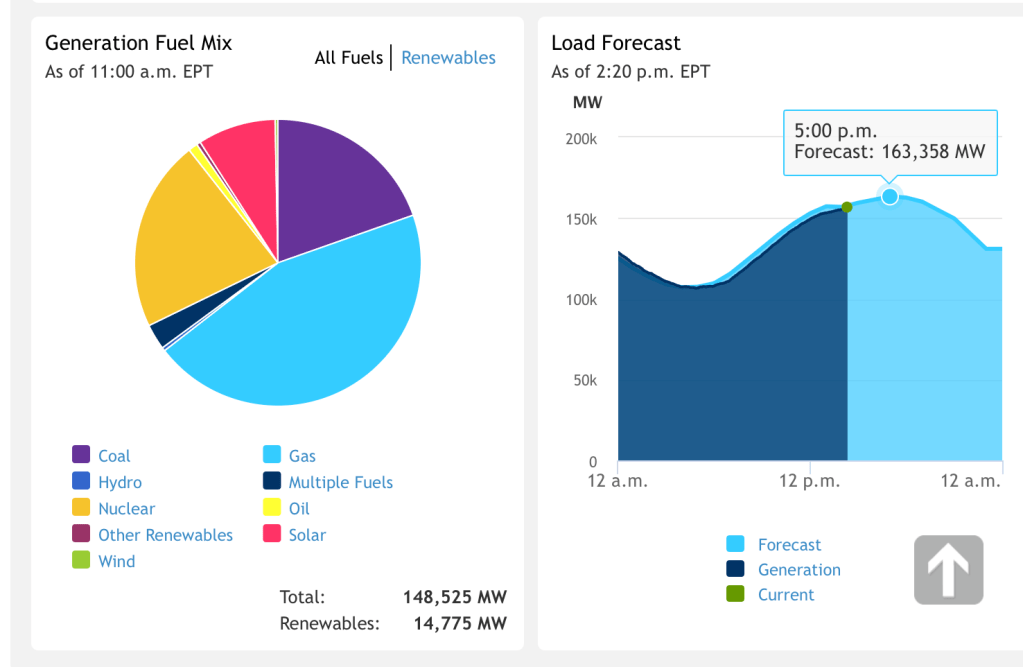
Thermal power generation by natural gas fueled gas turbines is the most common for Dispatchability when electricity demand rises. As an example, let’s take a look at the PJM Interconnection on July 2, 2026. Gas, nuclear and coal provided most of the electricity generation needed with gas providing nearly 50% of total electricity generation.
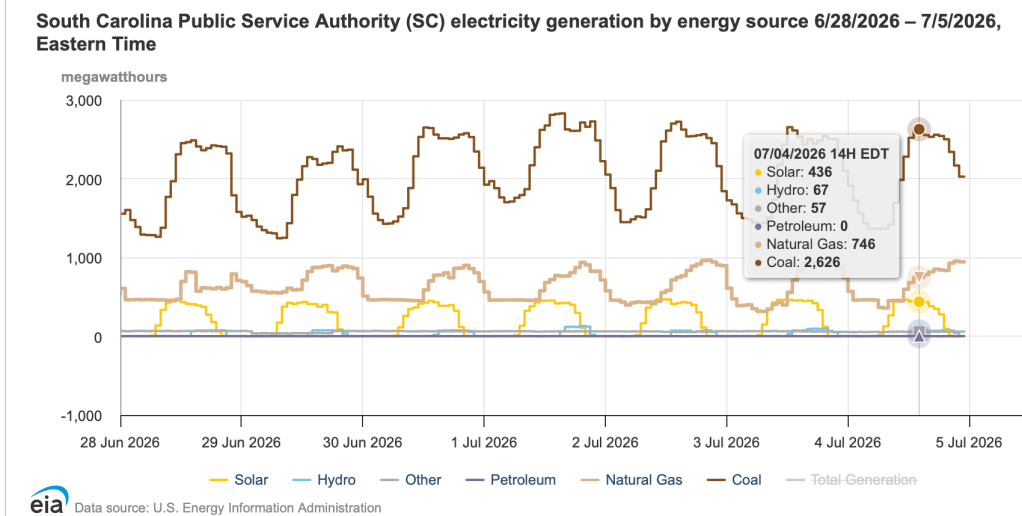
In coastal South Carolina, Santee-Cooper generation that same week was mostly coal power generation, with coal providing about 60% of the total generation.
The immediate thought may be, “So what”. It doesn’t matter whether coal or gas provides much of the electricity generation needed. This is true, when gas and coal are close to the same cost on a heating value per million BTUs basis.
About 80% of electricity generation in the U.S. is by thermal power generation using gas, coal and nuclear fuel. Let’s take a look at how fuel cost contributes to the cost of electricity production.
Coal and Natural Gas Fuel Cost Comparison
The cost of power generation from fuel alone will be calculated to show the production cost of power from coal and natural gas. The is for fuel only, not including capital cost, operations and maintenance, transmission, taxes, distribution costs and power line maintenance. Just the fuel to produce power. The chart below shows fuel cost (primary energy cost) for coal and gas. The prices quoted are the current prices from the EIA Electric Power Monthly cost reporting.
| Coal Average Coal Plant | Gas (CCGT) | |
| Cost $/MM BTU | $2.52 | $2.89 |
| Fuel Cost to Produce 1,000 kWh of electricity | $0.0265/kWh $26.50/ MWh | $0.0197/kWh $19.70 MWh |
| Heat-Rate BTU/kWh | 10,500 | 6,825 |
| Market Fuel Cost basis | $83.00/Ton | 2.89/MMBTU |
| Efficiency of Power Plant | 32.5% | 50% |
The example above shows how a modern high efficiency combined cycle gas turbine when purchasing gas fuel at slightly higher cost/million BTUs, can produce power at less cost than an existing average efficiency subcritical coal plant.
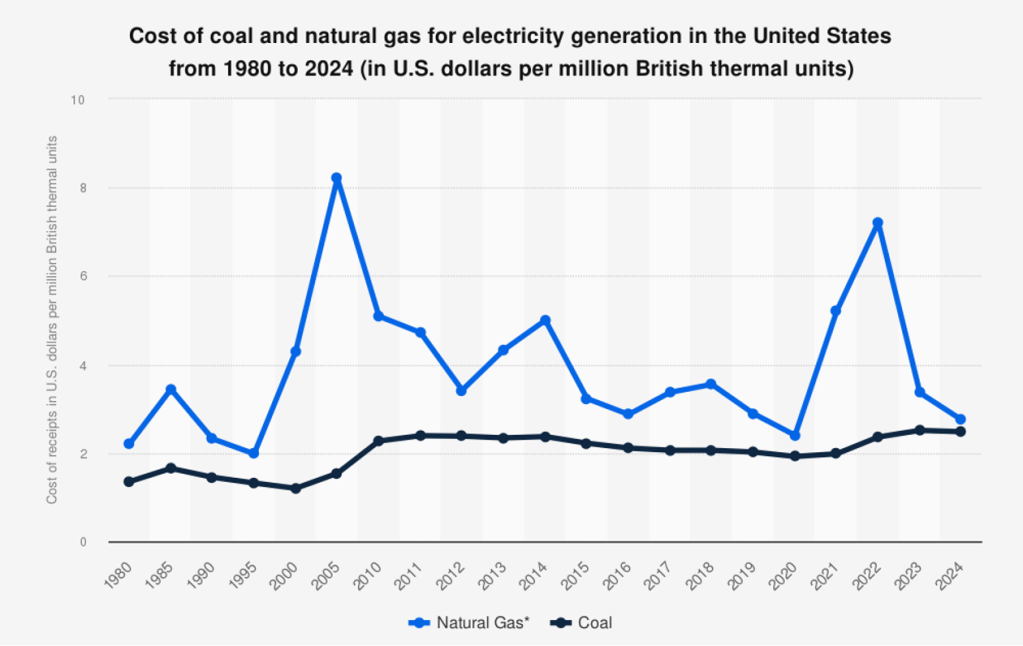
The $0.02/kWh production cost represents about $20.00.Megawatt and is about normal (fuel cost component only) for today. The Shale Gas Revolution has been a great boost to American energy independence and also has contributed to keeping electricity production costs low (where gas is available) for over 15 years. But, the world energy markets are more volatile in 2026 than has been normal for many years. Some of the hydraulically fractured gas is converted to LNG and exported. This is good for our allies, America’s trade balance and also for American businesses. However, the downside for the U.S. is that gas prices when connected to world markets are likely to rise when world market prices rise, especially in winter. The IGU report of World LNG reported and average cost of LNG on world markets in 2025 was $12.61/MMBtu. The chart below shows the comparative U.S. costs/million BTU between coal and natural gas 1980-2024. As the chart shows, American coal prices have been constant, whereas gas prices are volatile.
Let’s see what happens to the electricity production price when gas reaches $7.00/MMBtu. By the way, gas prices in Europe and Asia are higher. Similar to world oil prices impacting U.S. gasoline and Diesel prices, once exporting of LNG becomes large scale, the world market price for natural gas is likely to affect the market process of pipeline gas supplying U.S. power plants.
The production cost of electricity from the same highly efficient, combined cycle, gas turbine plant using $7.00/MMBTU fuel would increase to $0.0478. or $47.80/MWh. This is more than double the production cost today. Coal costs of the future are not guaranteed, but the historical constant price has been an average of about $81.00/ton and the U.S. has enormous reserves of high quality coal and build in infrastructure to move the coal from mine to power plant.
A Balanced Generation Portfolio Matters
My nuclear engineer friend Don Spellman and I wrote a blog post on our concerns for installing enough new Dispatchable electricity generation capacity to meet the growing Demand for electricity in the future. In that article we showed our recommended generation capacity by type to be 30% Gas, 30% Nuclear and 30% Coal. The fuel cost volatility as mentioned above is one reason for a balanced generation portfolio. Electricity generation security and resilience of the Grid is another reason to have 60% power generation provided from nuclear and coal. Too much pipeline supplied, “just in time” natural gas fuel places the U.S. at risk of Blackouts from fuel interruption
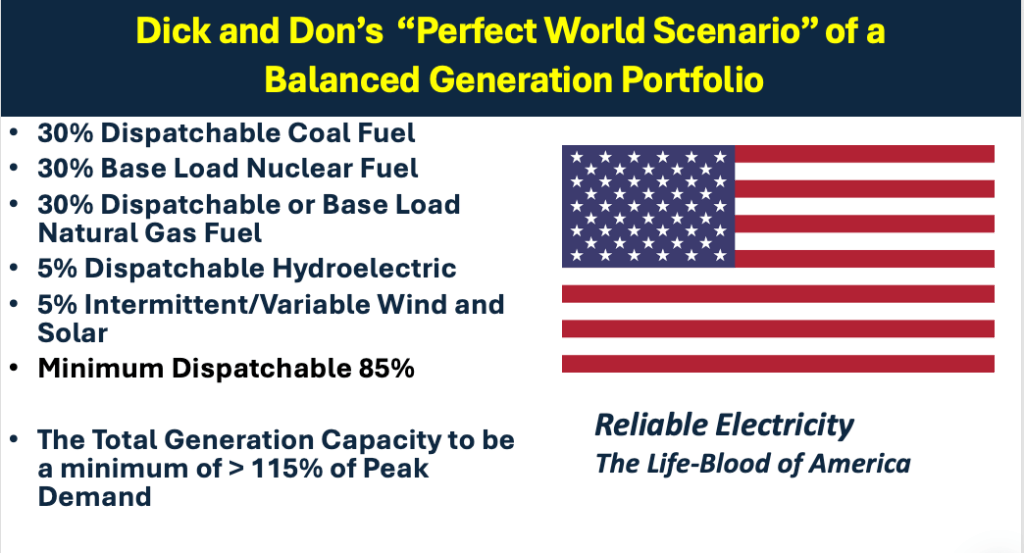
A Balanced generation portfolio is strongly preferred by the author, for national security as well as for electricity price stability.
The Fuel Cost Component for Electricity Production at $12.00/MMBTU
As mentioned above, the world market price for LNG in 2025 was $12.61/MMBTU. How would this impact electricity production in the U.S. if natural gas prices here reached $12/MMBTU?
Well, the production cost of fuel to generate one Megawatt would increase from about $26.50/MWh to $81.90/MWh. Yes, the production cost is pretty much exactly proportional.
Conclusions
- America is on a path of ever increasing electricity costs because of the new electricity generation capacity being installed is wind, solar, batteries and gas turbine back up.
- The anti carbon influencers have planned for higher electricity costs for decades. They figure that higher cost electricity will help to make solar and wind look closer to being affordable
- As electricity prices rise, it makes it very difficult for electricity intensive industries to compete on world markets. Such as aluminum, steel and AI-Data Centers
- It will be difficult for America to change our path due to extremist NGOs and SWAMP Bureaucrats in the Deep State
- About 150 coal plants were shut down over the last 10 years and only a handful of new ones are planned. New nuclear is also still held back by excessive U.S. federal Regulations.
- As a result of the above, more dependence will be on natural gas electric power generation with fuel that costs significantly higher than coal power, an example is building the new 2,200 MW gas plant at Canadys station which replaces the coal plant that existed there before
Dick Storm, August 28, 2026
References and articles for further research:
- Musings of two experienced engineers, one Coal Power and one Nuclear Power, June 2026: https://powerfortheusa.com/2026/06/30/musings-of-a-nuclear-engineer-and-a-coal-power-engineer-on-the-adequacy-of-bulk-power-supply-for-the-future/
- The Axis of Evil in Climate Policies, August 2026: https://powerfortheusa.com/2026/08/17/some-of-the-axis-of-evil-regarding-climate-policies/
- Back to Basics: The A Primer on the Sources of Primary Energy, August 22, 2026: https://powerfortheusa.com/2026/08/21/back-to-basics-a-primer-on-primary-energy/
- International Gas Union report on World LNG: https://www.igu.org/igu-reports/2026-world-lng-report
- Conventional Energy Including Coal is the Life-Blood of America: https://dickstormprobizblog.org/2025/06/18/conventional-energy-including-coal-is-the-life-blood-of-america/
- Thomas J. Shepstone published version of Dick Storm blog post on the “Madness of the Self-Inflicted Electricity Generation Crisis” https://open.substack.com/pub/energysecurityfreedom/p/the-madness-of-the-us-self-inflicted?r=kv1a9&utm_campaign=post&utm_medium=email
- Dick Storm Thoughts on Energy and the Way the World Really Works, May 2026: https://powerfortheusa.com/2026/05/21/thoughts-on-primary-energy-and-the-way-the-world-really-works/
- Santee-Cooper Gas Plant to be built at the old Canadys Coal Plant site: https://www.santeecooper.com/community/generation-projects/canadys-station/
- Santee-Cooper latest Integrated Resource Plan, 2025: https://newsroom.santeecooper.com/wp-content/uploads/2026/04/Santee-Cooper-2025-IRP-Update__2_.pdf
- Transitioning from fossil fuels, the absurdity of it, Aug. 25, 2026: https://energysecurityfreedom.substack.com/p/transitioning-away-from-fossil-fuels?r=kv1a9&utm_campaign=post-expanded-share&utm_medium=web
- EIA Energy Cost Converter: https://www.eia.gov/energyexplained/units-and-calculators/energy-conversion-calculators.php


Leave a Reply