This document summarizes discussions of Don Spellman, a senior nuclear engineer, retired U.S. Navy Submarine officer and Dick Storm, a retired coal power engineer. We have had ongoing discussions for several years regarding the inadequacy of new replacement of Dispatchable or Base Load capable coal and/or nuclear power plants. Therefore, We decided to jointly write this article to share our views.
Introduction
America’s Grid grew from the days of Edison, Tesla and Westinghouse to about the 1990’s in an orderly, well planned manner. Both wholesale and retail electricity was both reliable and affordable. America’s Grid was the best in the world. Up until that time, planning for growth was done by regional, regulated utilities such as Duke Power, Virginia Electric Power Company (VEPCO), Carolina Power & Light (CP&L), Philadelphia Electric, Potomac Electric Power Company (PEPCO), Delmarva Power, South Carolina Electric and Gas (SCE&G), Santee-Cooper and many others across the 48 states. Each of these Regional Utilities were accountable for future new generation planning, constructing new generation capacity and transmission & distribution equipment, selecting the most appropriate new generation fuel and planning for growth. That was then. About 1990 there became a movement to De-Regulate Electric Utilities and to separate electricity generation from Transmission and Distribution. Not all states agreed to this, but many did and the huge PJM Interconnection which includes most of the northeast between NJ and Illinois serves as a controlling agency to determine which power generation will be utilized based on the lowest price bid. PJM and the other RTO’s such as MISO, ERCOT, NY-ISO, NE-ISO, CAISO serve as “Air Traffic Controllers” to direct Bulk Power from the least cost generators.
It should be mentioned, of the once fine Regional Utilities mentioned above that have merged with others and become part of the PJM Interconnection, at this writing, Santee-Cooper in South Carolina remains as one of the sole survivors. The S.C. Legislature may yet kill it, but as of today, Santee- Cooper is alive and well and at peak generation periods, still generates most of it’s electricity from reliable, affordable coal plus 322 MW of joint ownership with Dominion Energy in the Summer nuclear plant.
Well, this de-Regulation model worked pretty well when we had an abundance of excess generation capacity, (1990-2012) when nuclear and coal provided about 70% of America’s electricity generation. It continued to work pretty well as the U.S. entered the “Shale Gas Revolution” about 2012 and natural gas became a lower cost fuel than coal and gas became the dominant source of primary energy to generate Bulk Power.
The EPA’s War on Coal hit its stride during the Obama administration and the Endangerment Finding was made a law, thus essentially outlawing the building of new coal plants. Electricity prices continued to be reasonable due to the switching of Bulk Power domination by coal and nuclear to natural gas. As long as gas remained below $3.00/ million BTU, this was no problem. Then the government incentives for wind and solar continued to escalate and because of subsidized wind and solar, it become attractive for both private generators and for Regulated Utilities. More and more wind and solar was forced (because of Federal subsidies that incentivized wind and solar) onto the Grid and backup generation capacity (as coal plants were shut down), has been by natural gas turbines. Long story shortened, what was once a very reliable Grid with regional accountability for investing in new generation capacity has become a hodgepodge of Dysfunctional Regulations, Rules/laws and Lawfare. Meanwhile, the public and energy policy makers have been wrongly indoctrinated into believing that wind, solar and batteries are less expensive and more environmentally acceptable than coal or nuclear power.
The two senior engineer authors of this article have watched this horrible breaking of our once well-tuned, reliable and well managed Bulk Power Supply and we remember the low cost, reliable electricity provided in 2008 which was about 50% coal and 20% nuclear power.
In the author’s opinions and experience, coal and nuclear are the two proven sources that must be deployed quickly to keep America’s Grid reliable, resilient and affordable. This is based on a combined 100+ years of experience. Our Bios are at the end.
Electricity Load Growth till 2050, Expected Demand and Needed Generation Resources
From FERC – “U.S. electricity demand is projected to surge by 20% to 25% by 2030 compared to today’s levels. This sudden spike—driven by the AI and data center boom, industrial reshoring, and electric vehicle adoption—means that peak grid demand will jump from 760 GW to an estimated 850–930 GW.”
From NERC – “The North American electric grid faces intensifying reliability risks over the next decade as demand growth driven by data centers and artificial intelligence threatens to outpace resource additions”, according to the 2025 Long-Term Reliability Assessment (LTRA) released Jan. 29 by the North American Electric Reliability Corporation (NERC).

90 GW of New Dispatchable Generation is Needed by 2030
Total PEAK electric load of the lower 48 states is expected to rise from 760 GW to 850 GW by 2030. So, let’s do the math
(850 – 760 = 90GW minimum needed by 2030. (= 90 GW/4 yrs = 22 GW per year).
The U.S. currently has about 1,400 GW of installed generation capacity. About 97 GW of existing nuclear generation with an average age of about 40 to 60 years. Therefore the 90 GW minimum needed capacity by 2030 according to FERC is about a 12% increase in total generation capability. This new generation should be capable of 24/7 Dispatchable or Base Load capable. Only nuclear, coal and natural gas generators can provide base load capacity plus being able to “follow the load” at peak summer and winter needs.
Nuclear power plants once on-line can achieve a 96% base load capacity factor as Duke Energy has proven. Well run coal plants can achieve a 24/7 capacity factor of over to 75% when properly operated and maintained. Future electricity load growth of the magnitude of 100-170 GW by 2030 has been forecasted by FERC, NEMA, ICF and others.
90 GW of New Dispatchable Generation by 2030: So,What are the Options?
The electricity growth in the next decade, if we are to continue a growing economy and including improve industrial production, reshore manufacturing, power EV’s, AI-Data Centers is like to grow by 90-100 GW. This is not hyperbole or exaggerated growth expectations, to expect electricity peak Demand to grow and require 90+ GW New Generation. We think this is a realistic estimate.
Annual Additions Needed for peak generation: 850 – 760 = 90GW minimum needed by 2030 (= 90 GW in 4 yrs is 22 GW per year). So, the U.S.will need to add about 22 GW of generation capacity every year to keep up, roughly double the historical pace. 90 GW/year is about 7 -1,300 MW nuclear units or 15 – 800 MW coal plants or 10 – 880MW Combined Gas Cycle gas plants or, obviously, a mix of these discounting the contribution from wind or solar units as they do not provide base load capacity nor load following capability and have capacity factors between 25 -35%.
The new generation capacity in our analysis should all be Dispatchable power generation capacity. Dispatchable means it can respond to demand immediately, as soon as it is needed to meet peak power summer and winter loads. Reliable, Dispatchable and Base Load generation of Bulk Power has been proven over decades to be affordable by Nuclear, Coal and Gas fueled thermal power plants.
How About Building an appropriate number of New Coal Plants by 2030 or 2050?
To put this in perspective of new coal plants. Let us look at the Cross Generating Station owned and operated by Santee-Cooper in the lowlands of South Carolina. This coal plant has modern FGD and emissions controls. It is an example of a clean coal plant. The four units, each about 600 MW in capacity was constructed between 1984 and 2005. The 4-unit plant is rated at 2350 MW. Let that sink in. This is about the same generation capacity as the Vogtle nuclear expansion of units 3 and 4 which took over ten years to build. The coal plant below was constructed over a 20 year period.
Our key point: 22 GW of new, Dispatchable generation is realistically impossible to build in four years.
90 GW of new Dispatchable Generation is the equivalent of 38 plants similar to Cross Generating Station
Dr. William Happer of the CO2 Coalition presented a description of a modern coal fueled power plant with Alice’s breath. The slide of Alice’s breath below is from Dr. Happer’s presentation.


The numbers are “Ball Park” approximate for a coal power plant. For a nuclear power plant, of course, the cooling tower plume would have no CO2 and only water vapor. Such as is shown below in the photo of the Vogtle nuclear power plant.

Above is a picture above of the 2 new 1100 MW Vogtle Nuclear units. The white plume emitted from a modern nuclear plant is entirely water vapor and even purer than the above picture of Alice’s breath.
Georgia Power’s Plant Vogtle expansion. This is about 2,200 MW of new capacity that was installed in the last dozen years. That 2,200 MW of new capacity required $35 Billion dollars of capital expenditure including the initial fuel load and 12 years to complete. Delays were primarily due to poor management practices, changing regulations. and supply chain issues. This plant has two similar sized Westinghouse reactors with an experienced workforce available at an existing plant. It still took 10+ years to complete.
If the 90 GW of new capacity could be achieved by building new nuclear units like Plant Vogtle, then it would take about 77 new 1,300 MW Vogtle like nuclear units 3 & 4 to be built in the next 10 to 25 years. Current reorganization at the Nuclear Regulatory Commission should lead to a significant reduction in nuclear plant construction time and cost.
Don Spellman spent 20 years in the nuclear NAVY, 11 years consulting to 4 new build reactors related to design control and configuration management and then 26 years at Oak Ridge National Laboratory as a lead engineer for nuclear fuel development, implementation of DOE’s Mixed Oxide Fuel Facility at Savannah River National Laboratory and implementation at ORNL of a spent fuel examination facility. Therefore, the comments and discussion regarding nuclear are from an experienced nuclear power engineer.
The Barakah Benchmark on Building A Major New Nuclear Plant
The United Arab Emirate (UAE) is the largest nuclear energy producer in the Arab region. The UAE’s Barakah Nuclear Power Plant generated 5.6 GW capacity from four APR-1400 reactors supplying 25% of national electricity. In relation with a the Korean Electric Power Company (KEPCO) partnership, IAEA standards for transparency and nuclear non-proliferation, the Federal Authority for Nuclear Regulation (FANR) regulatory framework, and a workforce development program, UAE completed construction and operation all 4 plants from UAE approval and groundbreaking to full operation on budget and on cost in 10 years at a total cost of approximately $24.4 billion. Each reactor produces 1,400 MW of electricity, totaling 5,600 MW (5.6 GW) for the entire plant. Each reactor is designed to operate for at least 60 years.
The UAE recognized from the outset that the success of its nuclear program requires more than just building reactors, it demands building a qualified workforce capable of operating and maintaining these facilities with high competence for decades to come. Accordingly, ENEC launched an ambitious nuclear workforce development program considered one of the largest nuclear qualification programs in the world.
The Barakah plant delivers enormous economic and environmental returns that extend far beyond electricity generation. According to analysis from S&P Global and nuclear industry sources, these returns include:
- Natural Gas displacement. The plant saves the equivalent of 21 million tons of liquefied natural gas annually that would otherwise be burned for electricity generation, allowing the UAE to export this gas and increase revenues.
- Electricity Cost Reduction: Nuclear energy produces electricity at a low and stable operating cost compared to volatile natural gas prices, saving billions of dollars over the long term.
- Carbon Emission Reduction: The plant prevents the emission of more than 22 million tons of CO₂ annually,equivalent to one-third of the UAE’s electricity sector emissions before the plant’s operation.
- Energy Security: The plant provides a stable and reliable energy source operating around the clock regardless of weather conditions — a critical advantage over solar and wind energy.
- Energy Mix Diversification: Barakah contributes to reducing the UAE’s dependence on a single electricity source, enhancing economic resilience and reducing exposure to global energy market volatility.
The Barakah Nuclear Power Plant is a living testament to what can be achieved when strategic vision meets commitment to the highest international standards and investment in human capital. With the continued successful operation of its four reactors and growing regional nuclear ambitions, the UAE is laying strong foundations for a new era of clean energy in. an era driven by technology, transparency, and international cooperation toward a more sustainable future.
Much of the U.S. fleet of nuclear plants was built to similar time lines and construction efficacy. However, that was in the 1960’s-1980’s before Federal Regulations combined with NGO Lawfare strangled the industry. Can we do it again? We hope so.
How About Building An Appropriate Number of Combined Cycle Gas Fueled Plants by 2030?
An 880-megawatt (MW) gas-fired electric plant usually operates as a combined-cycle unit, capturing gas turbine exhaust heat to produce steam supply to a steam turbine, thus the name Combined Cycle, Gas Turbine (CCGT) These machines are the most thermally efficient generators known to mankind and they approach 64% thermal efficiency under ideal conditions. A notable regional example is the Delta Energy Center: An 880-MW combined-cycle plant located in Pittsburg, California. Natural gas is the default fuel for power generation for quick response new power generation. Every new MW of new bulk power that is installed by wind and solar generation must be backed up by dispatchable bulk power that can to be brought on-line when the sun sets and the wind stops. Gas powered generation It is the easiest form to get permitted to build. Utility executives prefer gas fuel because it is also the least capital intensive and faces the least resistance from NGOs and public opposition. Because of these economic realities in a thoroughly dysfunctional regulatory environment, natural gas has risen to become the primary fuel source for power generation. Now at about a 43% of the total U.S. electricity generation.
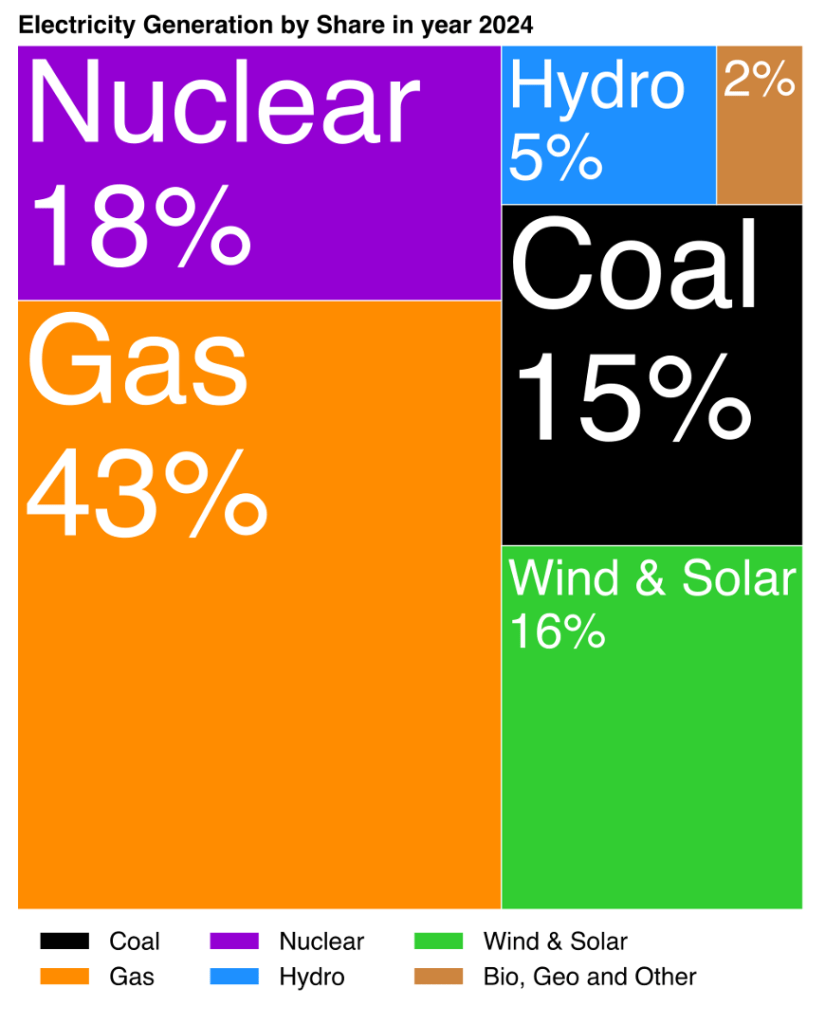
Natural gas has replaced coal as the largest primary energy source since the revolutionary advances in hydraulic fracturing for natural gas production. Before the shale gas revolution, coal provided about 50% of electricity production and nuclear about 20%.
Here is a picture of a typical CCGT power plant. This one is 600 MW. Notice the stack plume? Like a modern coal or nuclear plant the stack discharge is mostly water vapor. Natural gas when combusted creates nine pounds of water for every pound of hydrogen in the natural gas fuel. Each molecule of methane gas CH4 has four molecules of hydrogen, thus the dense white plume of water vapor on a cold winter day.

Back to CCGT capacity to meet the 90 GW of new generating capacity by 2030. It would take 102 (880 MW each) units such as the Delta plant in California to produce 90 GW
America Needs a Balanced Generation Portfolio for the Grid
Combined cycle power plants (CCPP or CCGT) are highly efficient systems that generate electricity efficiently and cleanly. However, in our opinion, America is already too dependent on pipeline supplied gas supplies now and increasing the CCGT fleet will only exacerbate that single fuel dependence. For Grid reliability, resiliency and to provide adequate quantities of affordable Bulk Power, we believe a Balanced Generation Portfolio is optimum. Such as, shown below.

Fuel is the Major Cost Component in the Production of Electricity in a Gas Power Plant
Natural gas has been abundant and cheap since about 2010. The U.S. produces more gas than any other country and has begun exporting as LNG. The cost of gas, however, has been volatile and will likely remain volatile based on Global demand, much like crude oil and other commodities traded globally. Here is a chart comparing the cost of gas to coal over the last 44 years.

The cost component of power production from a CCGT is about 90% fuel cost. Thus, if the fuel cost doubles as it has in the past during extreme demand periods, so does the production cost of electricity double. Thus, our recommendation of a Balanced Generation Portfolio which includes 50-60% installed coal and nuclear generation capacity.
Another consideration is national security and Grid Resilience. If nearly 50% of America’s Bulk Power is generated from pipeline supplied gas (43% now and growing) and there is a major pipeline failure, then power shortages can occur. Keep in mind winter storm URI in 2021 and the resulting Texas blackout. A coal plant has on-site fuel storage capability for months, nuclear, years of on-site energy storage. Batteries, hours.
Historical Bulk Power Generation When Coal and Nuclear Provided Approx. 70% of America’s Power
These were the good old days. In 2010 Coal provided about 50% and nuclear about 20% of the fuel for America’s Bulk Power Supply.

The chart of electricity cost trend in the U.S. by states below is from 1978-2025 by the St. Louis Federal Reserve.
Compare the electricity costs from when nuclear and coal provided over 70% of America’s electricity to after 2020 when the “Green New Deal” also known as the Inflation Reduction Act” was passed into law. After spending billions on wind and solar, the electricity costs have steadily risen and the future electricity supply reliability is compromised. Here is a trend of electricity prices across the U.S. since the huge investment in wind and solar and the destruction of reliable coal plants without replacing with in-kind, Dispatchable power generation capacity.

The map of the U.S.A. below with electricity costs by state is from 2010 data. As shown by the St. Louis Fed. graph above, since 2010 electricity rates have grown about 75%.

Conclusions
- Since about 2012 American energy policy has been created by academics, politicians, NGOs, green energy advocates, educational institutions, the UN, the WEF, the MSM and others, none of which have any practical experience in electric power generation such as the authors of this article. The energy policy was driven by ideology and politics, not science, engineering or sound economics
- America’s misguided energy policies have Self-Sabotaged the U.S. Bulk Power Supply by shutting down reliable coal and nuclear plants Since 2010, over 150 GW of Dispatchable or Base-Load capable nuclear generation has been shut down. One might make the connection that the new generation capacity forecasted to be needed by 2030 is about the same magnitude as the capacity of demolished coal plants since 2010

- The destructive Net-Zero Carbon path set by Congress and most states, is still in place. The inspiration of President Trump’s energy policies to apply common-sense and science based solutions is appreciated, but resistance remains. President Trump’s Executive Order Declaring and Energy Emergency has NOT yet moved the private sector to begin the process of building the number of new coal or nuclear plants needed to meet all of the anticipated electricity generation increases of the future
- The authors of this article are not the sole experts that understand the shortage of future Bulk Power Supply. There are also well respected organizations that have been publishing reports as outlined by us: Examples: FERC and NERC
- A true electricity shortage and severely escalated electricity production costs are predicted beginning December 2026 due to the dereliction of duty of energy policy makers at both the Federal and state levels and complicated by NGO Lawfare.
- Building the needed nuclear and coal power generation over the next decade will be difficult for many reasons. Amongst them: Rebuilding the U.S. Domestic Supply-Chain will take time, including both training of new engineering and trade craftsmen talent in the workforce as well as manufacturing capacity. Further, Regulations must be updated or abolished, including the EPA Endangerment Finding, New Source Review and Rule by NRC and other Federal agencies, plus State Regulations, Utility management investment strategy to use the lowest cost fuels and the hardest challenge to overcome yet: Reversing the public indoctrination which demonized coal and nuclear, by educating the public on the true facts of energy and electric power generation
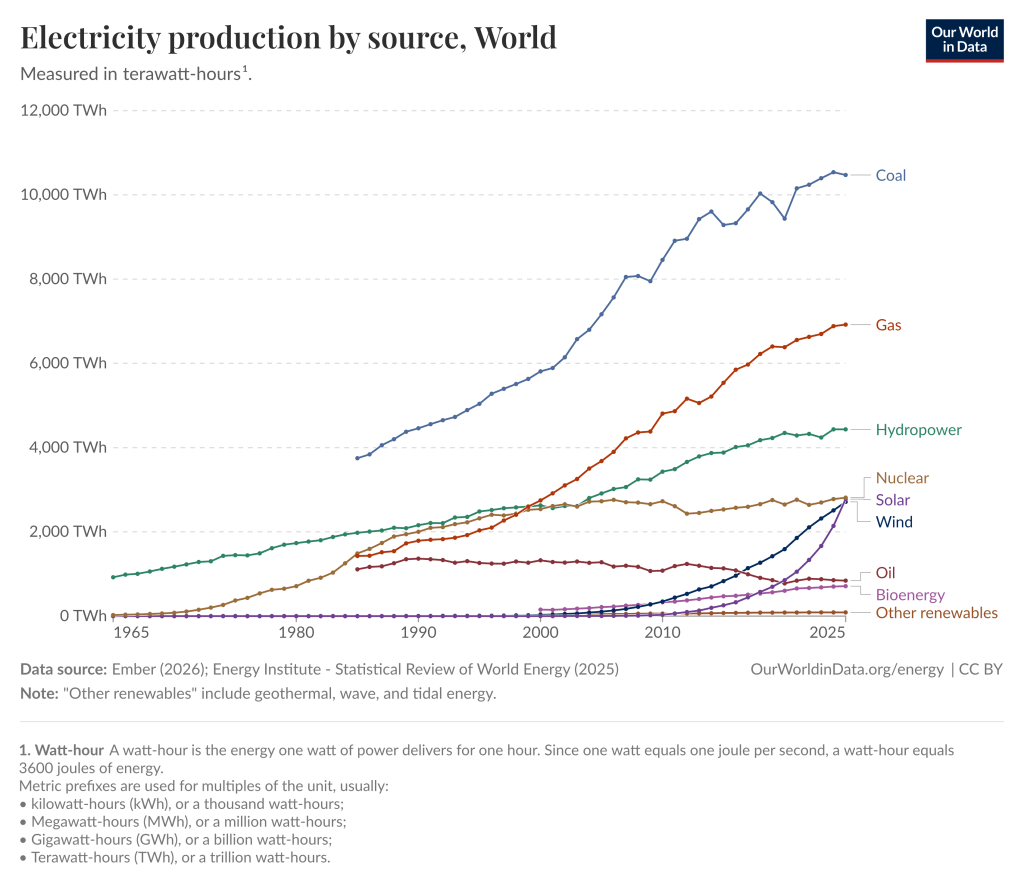
- Coal fuel is the number one choice of the world for a power generation fuel. More coal was burned for power production in 2025 than ever before in history:
- The states with the lowest electricity costs are mostly those states that use more than 50% coal fuel for electricity generation. Here is an example from a recent presentation by Dick Storm to the EPRI Heat-Rate conference in February 2026
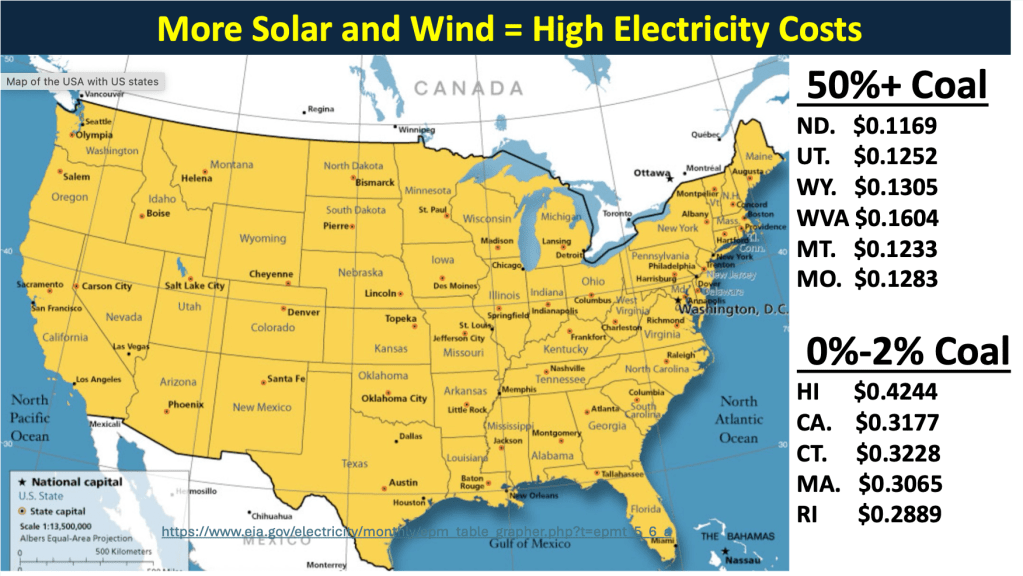
Tennessee which is provided power from TVA averaged $0.12/kWh during this same period. TVA is a unique with regard to Federal ownership.
Mark Twain’s quote on “The trouble with the world is not that people know too little; it’s that they know so many things that just aren’t so.”… seems very appropriate for the environmental extremists that have influenced energy policy. ...American energy policy has been formulated by politicians that know so much that is not based on physics, economics, common-sense and more importantly, the proven past successes of American progress in building the largest, most reliable electric Grid in history.
Policy makers should study the facts on energy, climate science, energy economics and most of all, review the past three decades of reliable and affordable power generation and modify the future policies to fit what has been proven to work very well; coal and nuclear power generation.
Respectfully submitted,
Richard F. (Dick) Storm and Donald J. Spellman
Dick Storm and Don Spellman Bio’s
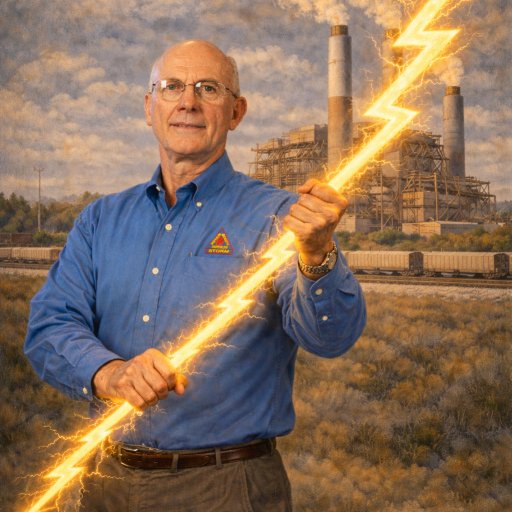
| Mr. Storm is a Registered Professional Engineer with over 50 years’ experience in coal electric power generation after graduating from Williamson College of the Trades in 1962. He started his engineering career as a Results Engineer for coal plant acceptance testing in 1965 with Babcock & Wilcox Inc. Then joined Riley Stoker Corporation as a Senior Service engineer to lead new plant startups. In that role he served as the lead startup engineer at numerous coal plants, including; Tampa Electric Company, the City of Lakeland Florida, Jacksonville Florida Electric Authority, South Carolina Gas & Electric, and Carolina Power & Light. |
| In 1973, he joined Carolina Power and Light Company and progressed from lead startup engineer on Roxboro #3 to Operations Superintendent of the 4-unit Roxboro Generating Station, from 1973-1977. |
| In 1977, Mr. Storm joined Flame Refractories, Inc. Technical Services Group. This engineering services group specialized in developing applied science solutions to improve large high pressure coal plant boiler performance and reliability and then as project manager of plant upgrades and pressure component modifications for improved reliability, coal fuel flexibility, reduced stack emissions and improved heat-rates. |
| In 1992, he founded Storm Engineering and Associates Inc. and soon after, Storm Technologies, Inc. and Fabricated Solutions. The company has continued to grow under the direction of his son Danny Storm who purchased the company in 2012, and since Dick’s retirement. Mr. Storm now serves as a consultant to Storm Technologies and as a part-time instructor of short courses in continuing education programs for the University of South Carolina Beaufort – Osher Life-long Learning Institute (UCSB-OLLI) related to current needs for energy and electricity generation. Over the years he has authored numerous articles for POWER Magazine and has published numerous technical papers and presentations. Storm continues to write on energy and electricity generation under his own blog post. |
Donald J. Spellman

In 1980, Mr. Spellman completed a successful 20-year military career in Navy nuclear submarines reaching rank of Lieutenant Commander and qualification as Nuclear Submarine Chief Engineer Officer. During his Navy career, Mr. Spellman received a Bachelor of Science degree in Electrical Engineering from Purdue University supported by the U.S. Navy and completed Master of Science studies in Ocean Engineering (nuclear programs) at the University of Rhode Island. in 1976. In 1976 He received a Commendation from the Commander U.S. Pacific Fleet for service as Navigator USS Snook during a Western Pacific deployment.
After Navy retirement, Mr. Spellman served as a project manager for Gas-Cooled Reactor Associates (GCRA) from 1980 to 1982, he provided supervision and technical direction for research and development of the modular high-temperature gas-cooled reactor.
After 1982 he was employed for 10 years in various roles as an engineering and management consultant for Management Analysis Company to the commercial nuclear power industry. He was responsible for directing utility assumption of design responsibilities after construction completion as a principal reviewer on the reactor plant Change Control Boards and conducted design change reviews at three different reactor plants.
In 1991, Mr. Spellman joined Oak Ridge National Laboratory as a member of the DOE Technical Standards Program and later as the Program Manager for ORNL support for the Fissile Materials Disposition Program Domestic Reactors Project in support of the Department of Energy (DOE) Office of Materials Disposition (NA-23). He had responsibility for technical support, research and development, and programmatic tasking associated with the U.S. reactor option for disposition of weapons-grade plutonium as mixed-oxide nuclear fuel. Mr. Spellman was a member of the DOE Source Evaluation Board for the selection of a prime contractor to provide design, construction, and operation of the Mixed Oxide Fuel Fabrication Facility at the Savannah River National Laboratory. Additionally, at ORNL he guided laboratory nuclear fuel development activities primarily related to nuclear fuel post irradiation hot cell examinations. He was a member of the ORNL High Flux Isotope Reactor (HFIR) independent safety oversight committee (Reactor Operations Review Committee). Primary responsibility for this committee was to periodically review operations and maintenance activities at HFIR and review periodic updates to the HFIR Safety Evaluation Report to the Department of Energy.
In 2017, Mr. Spellman retired from Oak Ridge National Laboratory after 26 years of service. Since retirement from ORNL, he served as a Subject Matter Expert on retainer back to the laboratory and for various other tasking for Xcel Engineering, Inc., Oak Ridge, TN.
Disclaimer
The sources of information in this treatise has been derived solely from public documents or websites and personal experience of the authors. No classified or proprietary information is included. For further interest of the reader, a list of references is provided below.
References and factual based technical information for further reading and reference
- Total Installed Electricity Generation capacity, 1400 GW, by American Public Power: https://www.publicpower.org/resource/americas-electricity-generating-capacity
- American Public Power 2025 report of installed generation capacity: https://www.publicpower.org/system/files/documents/Americas-Electricity-Generation-Capacity_2026-Update.pdf
- Drivers of Electricity Growth: https://gridstrategiesllc.com/wp-content/uploads/FINAL-2025-LTRA-Review.pdf
- NERC December 2025 Report on resource Inadequacy: https://www.nerc.com/newsroom/resource-adequacy-risks-intensify-across-north-america-as-demand-growth-surges
- POWER Magazine on Load Growth and Inadequate Bulk Power Supply: https://www.powermag.com/nerc-warns-long-term-grid-reliability-risks-mounting-from-surging-demand-lagging-resources/
- NERC Long Term Electricity Demand: https://www.nerc.com/globalassets/our-work/assessments/nerc_ltra_2025.pdf
- President Trump’s Executive Order, “Declaring and Energy Emergency”, January, 2025: https://www.whitehouse.gov/presidential-actions/2025/01/declaring-a-national-energy-emergency/
- Our World in Data, Electric Power Generation in the World, by Fuel: https://ourworldindata.org/grapher/electricity-coal
- Santee-Cooper 2025 updated IRP (Integrated Resource Plan): https://www.santeecooper.com/About/Integrated-Resource-Plan/presentations/Santee-Cooper-2025-IRP-Update.pdf
- Cross Generating Station: https://grokipedia.com/page/cross_generating_station
- Roxboro Generating Station: https://grokipedia.com/page/roxboro_power_station
- EIA on Coal Plant Shut Downs&nb sp;since 2010: https://www.eia.gov/todayinenergy/detail.php?id=67427
- Dick Storm presentation to the ASME Plenary Meeting in Dallas, TX, summer 2011 on the importance of coal power
- NERC Long Term Assessment: https://www.nerc.com/globalassets/our-work/assessments/nerc_ltra_2025.pdf
- EIA Grid Dashboard for lower 48 states Real-Time Generation data: https://www.eia.gov/electricity/gridmonitor/dashboard/electric_overview/US48/US48
- EIA on Fuels for electricity generation 1950-2025: https://www.eia.gov/energyexplained/electricity/electricity-in-the-us.php
- Grid Strategies on Load Growth: https://gridstrategiesllc.com/wp-content/uploads/2023/12/National-Load-Growth-Report-2023.pdf
- https://www.ferc.gov/news-events/news/fact-sheet-ferc-takes-action-supercharge-americas-grid-efficiency-reliability-and
- https://www.ferc.gov/news-events/news/presentation-report-2026-summer-energy-market-and-electric-reliability-assessment
- Over half of coal plant capacity will be shut down by 2026 by IEEFA (Institute for Energy Economics and Financial Analysis: https://ieefa.org/resources/us-track-close-half-coal-capacity-2026
- NEMA Electricity Growth Forecast to 2050 to be about 50%: https://www.makeitelectric.org/wp-content/uploads/Documents/News_Blogs/grid-reliability-study-nema-deck.pdf
- NEMA now predicts 55% capacity increase by 2050: https://www.publicnow.com/view/A42C2BC3294ACB64F9720CBD22AEC44186D3DE72
- Utility Dive on Load Growth in next five years: https://www.utilitydive.com/news/electricity-load-growing-twice-as-fast-as-expected-Grid-Strategies-report/702366/
- EIA on Coal Plant Shut Downs since 2010: https://www.eia.gov/todayinenergy/detail.php?id=67427
- Isaac Orr and Mitch Rolling, “Debunking the High Cost of Expensive Coal Power” June, 2026: https://open.substack.com/pub/energybadboys/p/debunking-the-myth-of-expensive-coal?r=kv1a9&utm_campaign=post&utm_medium=web
- Electric Rates by State: https://electricrates.org/guides/electricity-cost-per-kwh/
- Lars Schernikau Blog on Rethinking Coal, May 2026: https://unpopular-truth.com/2026/04/25/rethinking-the-cost-of-electricity/?utm_source=brevo&utm_campaign=2026-04%20Rethinking%20the%20cost%20of%20electricity&utm_medium=email
- Lars Schernikau. On “Coal Keeps the Lights on” April 2026: https://unpopular-truth.com/2026/03/18/the-new-renaissance-of-coal/?utm_source=brevo&utm_campaign=2026-04-04%20newsletter%20Coals%20return&utm_medium=email
- Georgia Power, Plant Vogtle Information: https://www.georgiapower.com/about/energy/plants/plant-vogtle.html
- Our World in Data Coal Power in world: https://ourworldindata.org/energy
A partial list of published articles and videos that help explain the roots of the path anti-American nuclear and coal energy policy that has plagued our country since about 2008:
- Excellent 2013 Documentary Movie to show some of the celebrities and politicians that changed Americans opinions on nuclear power. “Pandora’s Promise”. Available on Amazon Prime, Netflix, You Tube and Apple TV, worth watching if you never saw it: https://www.youtube.com/watch?v=KMutoR8YTlQ
- “The War on Carbon, How it Came to Be” October 2021: http://dickstormprobizblog.org/2021/10/16/the-war-on-carbon-how-it-came-to-be/
- 114th Congress, Majority Staff Report, Obama’s Carbon Mandate, August 2015: http://www.scientificintegrityinstitute.org/USSEWP080415.pdf
- Capital Research Center on CCP Influence of U.S. Environmental policy: https://capitalresearch.org/article/how-china-designed-american-environmental-policy/
- Wake Up America! Sept. 2023: http://dickstormprobizblog.org/2023/09/20/please-wake-up-america-your-energy-and-electricity-generation-reliability-are-at-risk/
- Watts Up With That Blog post on Lawfare in Louisiana, June 2026: https://wattsupwiththat.com/2026/06/22/louisiana-did-the-right-thing-by-blocking-climate-lawfare/
References on the environmental impact of carbon and climate science:
1 . CO Coalition References/Resources: https://co2coalition.org/media/
2. Dr. Happer presentation to Univ. of NC-2017 “CO2 is NOT a Pollutant: https://co2coalition.org/media/
3. Dr. Richard Lindzen, of MIT “The Absurdity of Conventional Global Warming Narrative” : https://co2coalition.org/wp-content/uploads/2022/10/The-Absurdity-of-the-Conventional-Global-Warming-Narrative.pdf
4. WUWT on the High Cost of the Endangerment Finding, April 22, 2026: https://wattsupwiththat.com/2026/04/21/the-end-of-epas-endangerment-finding-is-a-bigger-deal-than-the-iran-war/
5. Science Matters Blog post on the Climate Cult Madness: https://rclutz.com/2026/06/13/disband-the-climate-cult-madness-happer/
6. Trump’s Energy Agenda is Stalled due to DOJ and Endangerment Finding Lawfare: https://wattsupwiththat.com/2026/06/15/trumps-energy-agenda-is-being-undermined-by-his-own-justice-department/
7. Capital Research Center on the “War on U.S. Energy”, April 2026: https://capitalresearch.org/publication/capital-research-april-2026/


Leave a comment