“The cavemen had the same natural resources at their disposal as we have
today, and the difference between their standard of living and ours is a difference between the knowledge they could bring to bear on those resources and the knowledge used today…..” Thomas Sowell
Continuing Sowell’s quote….
“To produce sufficient energy that drives our economy, industry and nearly every comfort and convenience that we have come to enjoy since muscle power provided most of the energy for farming and transportation only 125 years ago…”
Introduction
Looking back on my career, my focus was always to first apply the fundamentals! Remembering the basics served me very well. This brings me to President Trump who issued his executive order on Jan. 20, 2025 declaring a National Energy Emergency. He was correct in doing so, because our nation is faced with an energy crisis that few of the public and few of our congressional leaders realize. Why? In my observation, this low energy awareness stems from three basic reasons: 1. Because there have been few widespread electrical Blackouts (yet) and no gasoline lines since about 1980, 2. Physics and Energy education of the public has been and remains minimal and 3. Green Energy indoctrination has been very effective to wrongly induce people to think renewable energy can totally replace our current sources. Thus, President Trump is aware and has urged Congress to act on solutions to focus on the fundamentals of primary energy to meet future needs. The public would also be wise to seek resources to update their understanding of basic knowledge regarding energy and electricity generation and support congressional actions.
We commonly use the term “Energy” as an all inclusive term for the types of power used in our everyday lives. In the proper context “Energy” includes electricity generation from a variety of sources and it also includes petroleum resources that create transportation fuels to power vehicles, trucks, airplanes, tractors, ships, trains and don’t forget the military equipment vital for national defense!
Let’s review facts on our electricity supply:
- The available electricity generation during peak winter and peak summer times, is very close to the Demand, which means there is not much in Dispatchable reserve electricity generation during Peak Load periods.
- Electricity is secondary energy and it must be produced from primary energy. About one third of all forms of primary energy is used to generate electricity the U.S.
- Electrifying Everything is impossible and transportation and Industrial production use much more primary energy than electricity generation
Public Disinterest
The public’s disinterest in energy policy is due to: 1. Effective green power indoctrination 2. A misunderstanding of the basic physics of thermal power generation and the concept of primary energy 3. The electric Utilities have done an exemplary job of using available generation to meet the Demand and so far, so far, avoiding major Blackouts.
The Root Cause of the Problem
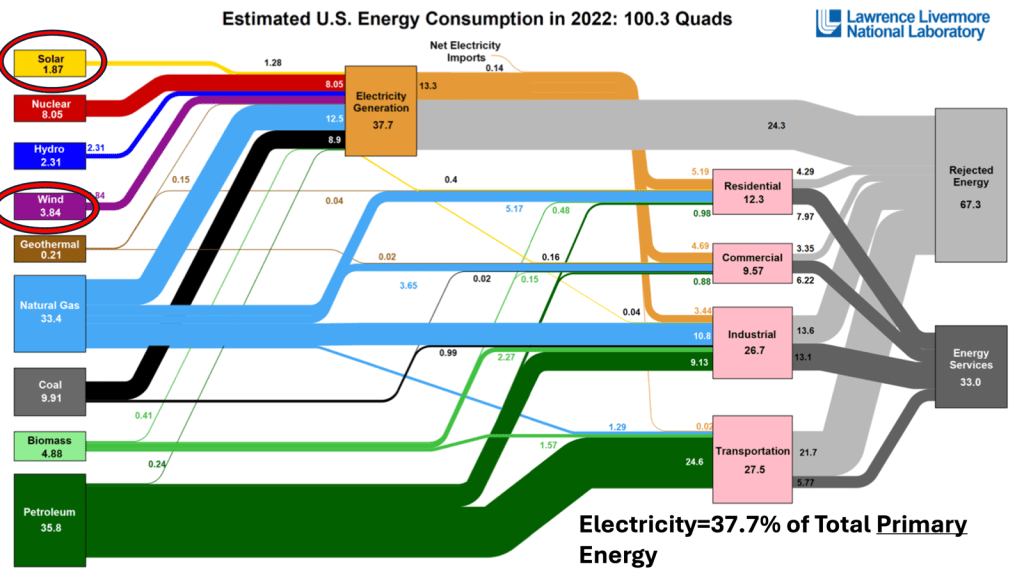
I believe America’s energy problem is rooted in a lack of understanding of the concept of primary energy. Energy and electricity become confused by many of the public. Electricity is secondary energy and the generation of electricity consumes a third of the total primary energy. The other two thirds is also important! This is shown on the Lawrence Livermore National Laboratory Sankey Diagram. It s linked here.
This. article is my attempt to create a primer on primary energy.
Primary Energy Use by Each Citizen: about 830,000 BTUs each day
The daily energy use of each U.S. citizen is about 830,000 BTUs. This multiplied by the U.S. population is about 100 Quadrillion BTUs of primary energy use each year for the U.S. A previous article discussed the importance of energy to power our lives and to live the American Dream = 100 Quadrillion BTUs per Year.
It is an understatement to say that when energy use of 100 Quads per year is presented to non energy experienced people, it is not understood. So, let’s see if primary energy and it’s importance to our every day lives, can be de-mystified.
Primary Energy, Our Servant
Let’s think about the start of our day and how primary energy is serving us. Just to place things into perspective, think about the opening quote by Thomas Sowell, one of the wisest and most practical Economists of my lifetime.
Sowell mentions how the Americans living 125 years ago. Back then, 70% of the citizens lived in rural villages and on farms. Willis Carrier had not yet invented air conditioning, there was sparse electricity service to rural areas, Carnegie was preparing to sell his steel factories and U.S. Steel was just beginning, Henry Ford had not yet begun mass producing automobiles and tractors were twenty five more years into the future before they would replace the horse for farm work and the invention and development of heavier than air airplanes were yet to come. America was just beginning to progress toward being the world’s #1 economy. Harnessing coal, hydroelectric and petroleum energy was the foundation of this enormous progress in our quality of life and thriving economy.
OK, now fast forward to 2026.
Our home inside temperature is controlled within 1 degree of precision, mom cooks our meals on either a gas or electric stove, we have electric lights at the flip of a switch. Our lawns are cut by power mowers. We regularly visit comfortable, well lighted and air conditioned shopping centers. All of our abundantly available food is produced by energy dense Diesel powered mechanized farming requiring less than 2% of the population. Food is transported in Diesel fueled trucks to electrically refrigerated processing and distribution centers and then to grocery stores. Commute time to work is minimized by modern highways and reliable automobiles. The grocery store shelves are stocked each day with fresh produce and meats protected from spoiling by refrigeration. When ordering a product from Amazon, it is shipped via ship or jet and then Diesel powered delivery vehicles. When we wish to visit friends hundreds of miles away or take a vacation, we can purchase tickets on line and then jet away with short planning to nearly any state or country in the world. Our toys, sporting equipment and recreational gear is largely manufactured from manmade materials, many of which are from petroleum based materials. The building materials for our homes have progressed from log cabins or stone buildings to clean, energy efficient comfortable abodes. Good jobs are made possible by reasonable cost energy to power Industrial output of steel, aluminum and to run AI-Data centers. America’s abundant and reasonable cost energy continues to be the foundation of our economy. Energy=Life.
What has made this possible? Reliable, abundant and reasonable cost petroleum, coal, gas and nuclear fuels. Petroleum, gas and coal are also used as feedstocks for materials to manufacture products over 6,000 products from petroleum alone, not just electricity generation or fueling motive power for transportation These raw materials are the foundation of what has improved the quality of life since the year 1900. Coal, oil, gas and uranium. Truly, abundant and reasonable cost primary Energy is what makes our high quality of life possible.
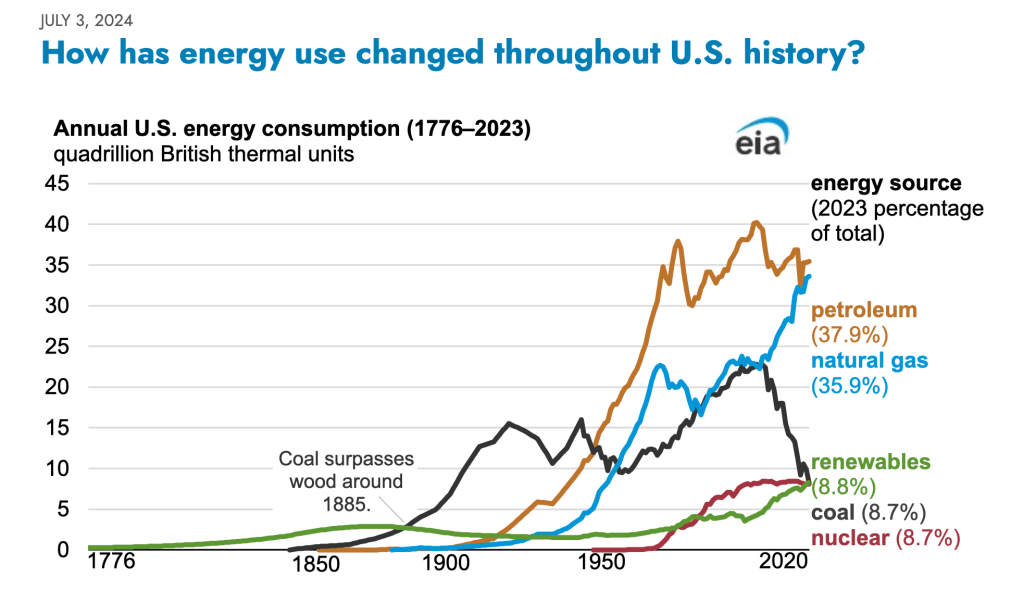
The primary energy use from the founding of America is shown on the chart below. Just imagine the changes in our industrial production, economic growth and comforts and conveniences that have come to be after 250 years.
There are some politicians and NGOs that literally wish for us to return to living as Americans did in the year 1900
Study this chart and think about the importance of energy in your life today. Yes, 91.2% of the primary energy we need to power our lives is from four sources: petroleum, gas, coal and nuclear.
Primary Energy Sources
There are six important sources of primary energy. These are: Natural gas, Petroleum, Coal, Nuclear, Biomass and Hydroelectric. These six provide over 90% of the primary energy used by the people of the U.S. and the world. Wind and solar provide about 6% and Biomass and other the remainder. Here are the sources (total 94.2 Quadrillion BTU) of primary energy America used in 2024:
- Petroleum 35.59 Quadrillion BTU
- Natural Gas 34.27
- Nuclear 8.17
- Coal 7.87
- Biomass 5.11
- Wind 1.54
- Solar 1.1
- Hydro-electric 0.83
- Geothermal 0.12
Why is Primary Energy Reported in BTUs?
A British Thermal Unit or BTU is a heat equivalent. It is the energy required to raise on pound of water one degree Fahrenheit. The units used in the U.S. are referred to as U.S. Customary Units and a BTU is the unit of energy that we have used for hundreds of years. In Europe and Asia International Units are used to express energy units. Usually the Joule or kiloJoule. A kilo joule is equivalent to 1.0551 BTU. Why is energy expressed in units of heating value? Because over 90% of the consumption of primary energy is used in HEAT Engines. Previous articles described heat engines: Here, Here and here.The internal combustion engine in an automobile, the Diesel engine in a truck or ship are heat engines. Both steam turbine and gas turbines installed at an electric utility generating station are heat engines. So are the jet engines of aircraft. Therefore, because of the preponderance of Heat Engines used to power our country, the total primary energy is reported in units of heat energy. Solar, wind and hydroelectric are reported in BTU equivalents.
For purposes of explaining primary energy, I will stick to using U.S. customary units of BTUs.
When American primary energy is reported by the Energy Information Administration or the Lawrence Livermore National Laboratory, the BTU was chosen to express all forms of energy. The solar, wind and hydroelectric energy represented by the government is shown in the BTU equivalence of converting electricity back to the heat energy equivalence. Which is 3,412.6 BTUs = 1 kWh.
A few common energy conversions are listed below:
| Energy Unit | BTU |
| 778 Foot Pounds of motive force | 1 |
| Kilowatt | 3,412.6 |
| 1 Gallon of gasoline | 114, 761 |
| 1 Gallon of Diesel fuel | 129,306 |
| 1 pound of Bituminous coal | 11,500 |
| One cubic foot of natural gas | 1,090 |
Now that we have our arms around the energy equivalences of various fuels and including wind and solar, let’s take a look at how this primary energy serves us each day to the tune of about 830,000 BTUs per person, each day.
Think about your home air conditioning and cooking. Typically the average American home uses about 861 kWh each month. Multiplying 861 x 3412.6=2,938,248.6 BTUs. Based on 4 members of the family, and dividing by 30 days per moth let’s round off at 25,000 BTUs for each of the four family members, each day, for electricity alone. Remember, electricity on a national scale uses only about 1/3 of the total primary energy consumed in the country. Next, think transportation.
Then, let’s consider driving to and from work and using say 3 gallons of gasoline. 3 x 114,761=344,283 BTUs
Just calculating the primary energy used for our home heating, cooling, refrigeration and transportation yields about 369,000 BTUs per capital energy use.
The national average of 830,00 BTU/day is based on in Total Primary Energy divided by the total population. Thus the energy used by people living in a small apartment will use less electricity than a family living in a suburban home. Likewise, not every person drives a car to commute to work. But then the energy used on behalf of all citizens must be included in the per capita energy consumption. So where do the other 461,000 BTUs per capita, each day get consumed?
Don’t Forget Industrial Production
The 830,000 BTUs per day, per person includes that energy allocated for each citizen for industrial production of steel and aluminum, manufacturing, commercial shopping centers, grocery stores, airlines, trucks, Amazon deliveries and much more. All of these uses for the common good are included in the expression of 830,000 BTUs per person, per day.
That my friends is why abundant and reasonable cost energy is important to power our lives. It is my hope that this short explanation makes the Lawrence Livermore National Laboratory Sankey Diagram of Primary Energy Flows more understandable. I used the 2022 version because it was right at 100 Quadrillion BTUs that year.
LLNL Sankey Diagram of Primary Energy Flows
Conclusions
- America has used 100 Quadrillion BTUs of energy +/- 6 since the year 2000
- Electricity currently uses about 35% of the total primary energy consumed in the U.S. and most of that generation is from Thermal Power plants by powering “Heat Engines” that convert heat energy into motive force to turn a generator. Coal, oil, gas, nuclear, Biomass and geothermal provide the heat to a Thermal power plant
- Electricity generation is the one secondary energy that can use most fuels that provide Thermal energy. Whether coal, gas, nuclear, Biomass or nuclear.
- The U.S. has used over 20 Quadrillion BTUs of coal annually and the infrastructure is still in acceptable condition to be ramped up from 8 to 25 Quadrillion BTUs per year
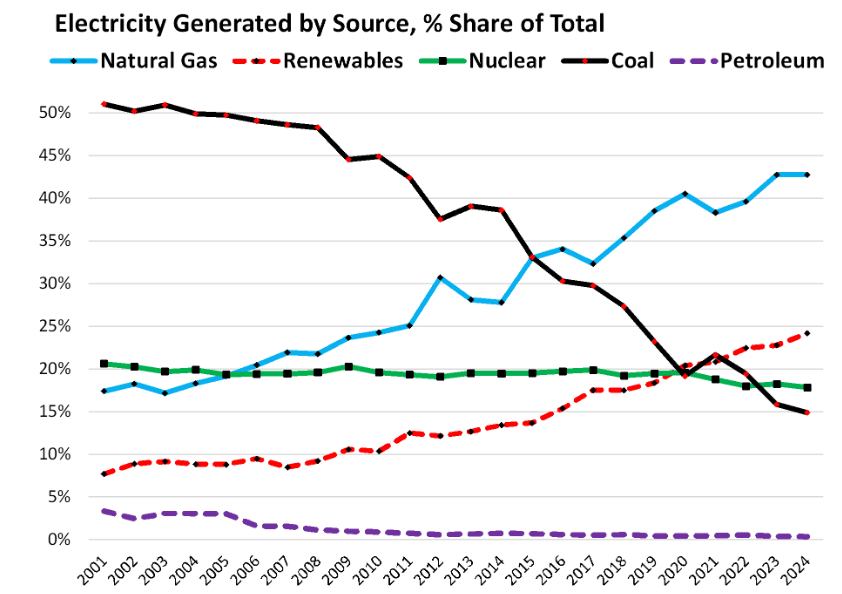
- Coal, oil or gas can be substituted to provide fuel for Thermal electric power generation. Note the chart below which shows the change in fuel sources for electricity generation over the last 24 years.
Closing
Thank you for taking time to read this. The purpose was to explain at a basic level, the importance of abundant and reasonable cost primary energy. Most of our electricity is generated in Thermal power plants. The source of heat for the generation of Bulk Electric Power can be from either coal, gas, nuclear or oil whichever is the most economical and/or available.
I hope this helps to demystify primary energy and electricity.
Dick Storm, August 22, 2026
For further reading and research, here are some additional references that, in my opinion, are informative and very well done:
- CO2 Coalition video on the Basics of the Grid and electricity generation, 2026: https://www.youtube.com/watch?v=zxY2lcwmANI
https://co2learningcenter.com/videos/#how-the-energy-grid-works - Prager University, Mark Mills on Energy Basics, 2022: https://www.prageru.com/videos/how-much-energy-will-the-world-need
Prager University on Electricity Supply, 2016: https://www.prageru.com/videos/where-your-electricity-comes-from - Alabama Power Company, James Miller Plant: https://www.youtube.com/watch?v=0ftl-WM6wms
- Intermountain Power Plant, Delta Utah, Tour and video: https://www.youtube.com/watch?v=rGtUtnqB94g
- CO2 Coalition Publications available On-Line: https://co2coalition.org/publication_category/member-publications/
- Dr. Lars Schernikau on the true facts about Energy, website “Unpopular Truths”: https://unpopular-truth.com
- CO2 Coalition, Dr. William Happer Short Explanation, “CO2 is Not a Pollutant” FOSSIL FUEL EMISSIONS FROM 1750 TO TODAY CAUSED NO HARM: https://co2coalition.org/wp-content/uploads/2026/04/Happer-Fossil-Fuel-attribution-4-23-26.pdf
- Dick Storm article on the Advancements in Cleaning Stack Emissions of Clean Coal Plants, May 2026: https://co2coalition.org/2026/05/14/progress-in-clean-coal-combustion-is-a-remarkable-achievement-so-lets-get-on-with-building-more-new-coal-plants/
- EIA Data on Primary Energy Production and Consumption, 2024: https://www.eia.gov/todayinenergy/detail.php?id=65524#
- Heating Values of Common Fuels, Engineering Toolbox: https://www.engineeringtoolbox.com/fuels-higher-calorific-values-d_169.html
- Watts Up With That on Gasoline Lines of the 1970’s: https://wattsupwiththat.com/2026/08/21/the-1970s-oil-crisis-never-forget/
- U.S. Grid-Real Time. This shows electricity being used in the U.S, in real time. It also shows electricity generation by fuel source and including wind and solar: https://www.eia.gov/electricity/gridmonitor/dashboard/electric_overview/US48/US48
- PJM Grid in real time. This shows electricity generation by the Regional Transmission Operator, PJM Interconnection which is the largest RTO in the U.S.
https://www.pjm.com/markets-and-operations - Similar to PJM, The Mid-America System Operator or MISO, RTO in real time:
https://www.misoenergy.org - The Electric Reliability Council of Texas or ERCOT, RTO. Similar t the above.
https://www.ercot.com/gridmktinfo/dashboards - The Gas Imperative by Amanda Van Dyke, August 7, 2026: https://amandavandyke.substack.com/p/the-gas-imperative?r=kv1a9&utm_campaign=post-expanded-share&utm_medium=web Energy and raw materials run the world. And the more closely you look, the harder it becomes to tell where one ends and the other begins. Remember this formula: energy + minerals + processing capacity = industrial power=economic power. It is the formula for the future.
- Mike Caravaggio post on Peak loads each year: https://www.linkedin.com/posts/michael-caravaggio_aside-from-january-every-month-this-year-share-7491976942020108288-Y9yv/?utm_source=share&utm_medium=member_desktop&rcm=ACoAAAI4KQUBYW-cbQRlA1kgj9X3llGi7u6KNnQ
- Stanford Energy Overview: https://understand-energy.stanford.edu/home%23your-guide-to-understand-energy-header/current-energy-landscape#energy-use-fuel
- A Practical Fix for Data Center Growth, WUWT, Aug. 2026: https://wattsupwiththat.com/2026/08/20/the-data-center-backlash-has-a-practical-fix/
- Pacific Northwest Power Growth Forecast, May 2026: https://www.nwcouncil.org/news/2025/05/02/pacific-northwest-load-forecast-2025/

 Power for the U.S.A.

Leave a comment